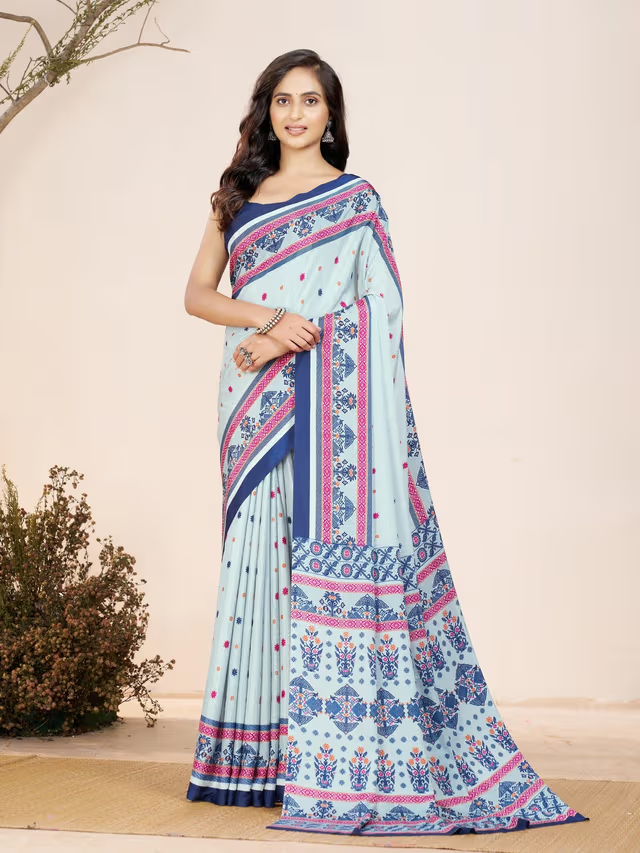
Blue floral crepe Garden Vareli saree

Surat · since 1921

The fabric decides everything

Start with how it should feel. The saree follows.

Shop by feel

Eighty years at the loom taught us that colour catches the eye but fabric decides whether a saree gets worn twice or twenty times. Pick the feel you want.

All 2,277 sarees →

Where are you wearing it?

Shop to your number

No filtering games. Four honest doors.

The archive

We made the everyday saree a fashion statement once. We still print our own cloth.

Garden Silk Fashions has printed in Surat since 1921. The mill is still ours, the prints are still drawn in house, and the cloth still leaves the same road it always did.

Read the archive
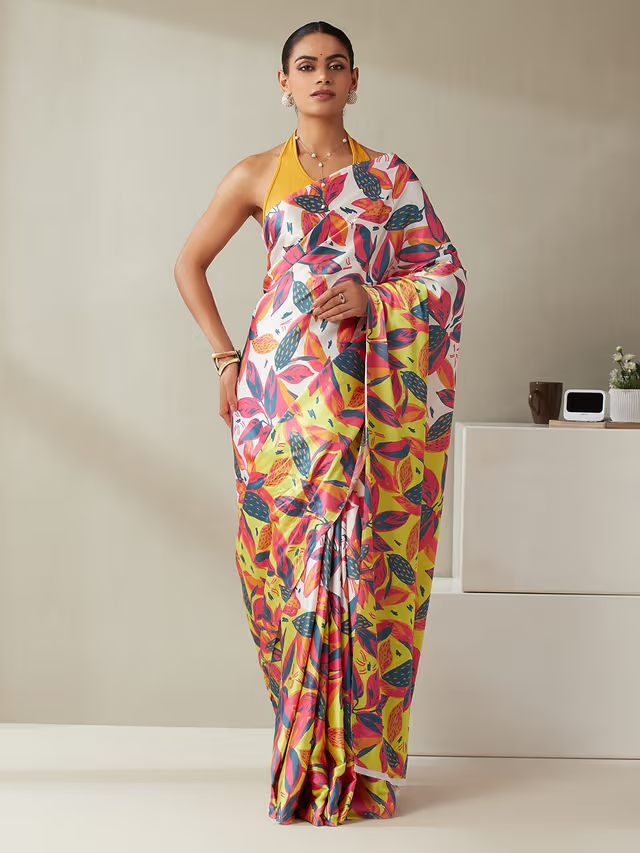
Red satin floral saree from the Garden Vareli archive

Occasion edit · Festive

The festive twelve

Richer tones, expressive prints, drapes that move under lamplight. Chosen for pujas, festive dinners and the photographs that follow. Picked by our design team in Surat, refreshed weekly.

See the edit →

Under ₹1,999

Everyday georgette and crepe, ready to drape.

Shop all →

Home · Sarees

Sarees

248 of 2,277 shown

Page 1 of 48. Every page has its own address, so search engines and your customers can reach all 2,277.

About sarees & fabrics, a buying guide

Georgette

Light, slightly grainy and forgiving. It holds a pleat without pressing and travels well, which is why it is the fabric most often reordered by our customers. Best for long days and warm weather.

Crepe

More structured than georgette with a soft, weighted fall. It reads formal without stiffness and photographs cleanly, so it suits office wear and daytime functions.

Chiffon

The lightest of the four, sheer and floating. It needs a fall stitched in to hang correctly, which we can add before dispatch. Best for evening events indoors.

Brasso and satin

Brasso carries a raised, burnt-out texture that catches lamplight, and satin brings shine with more weight in the hand. Both are festive fabrics rather than everyday ones, and both hold their drape through a long evening.

← Back to sarees

Blue floral crepe saree, full drape Pallu detail Fabric close-up

Crepe · Everyday

Traditional Print Crepe Saree

SKU CO060546C440BU0

₹1,556 ₹2,595 40% off Inclusive of taxes · ₹1,400 if you pay online
Colour Blue
What arrives in the box
  • ◆Saree, 5.5 m, finished edge
  • ◆Matching blouse piece, 0.8 m, unstitched
  • ◆Care card with wash instructions for crepe
How it wears
LightHeavy
MatteShine
Soft fallStructured
Add finishing optional
Delivery

Delivered in 3 to 5 days · free shipping · cash on delivery available

  • ◆Printed and finished at our own mill in Surat, Garden Silk Fashions, weaving since 1921.
  • ◆7-day easy returns, pickup from your door. Return rate on this fabric: under 4%.
  • ◆Delivered in 3 to 5 days to 400001. Check your pincode

Similar colours

Close to this blue. Same colour family, different fabrics, so you can keep the shade and change how it wears.

More in crepe

Same weight, same drape, same sheen. Only the print changes.

All crepe sarees →
₹1,556₹2,595 · 40% off

Your bag

2 item(s) · reserved for 30 minutes

Not what you wanted? Browse sarees

Summary

Subtotal₹3,455
Festive discount−₹250
ShippingFree
Prepaid saving (10%)−₹321
To pay₹2,884
Checkout

Secure payment · 7-day returns · WhatsApp support on every order.

Checkout

One page. No account needed.

1 · Where it goes

Pincode 400001 · delivery by Friday, 11 September

2 · How you pay

3 · Anything else

2 item(s)

Subtotal₹3,455
Festive discount−₹250
ShippingFree
Prepaid saving (10%)−₹321
To pay₹2,884

By placing this order you accept our returns and privacy policy.

Meera’s wardrobe

Shopping with us since 2019 · 11 sarees · prefers chiffon & georgette

Orders

Because you wear chiffon

Nine new chiffon prints landed this week, all under ₹1,999.

See them →
Saved measurements

Blouse 36 · sleeve elbow · back deep-V. Reused automatically on stitched orders.

Edit →
Festive alerts

On for Navratri and Diwali drops. We will message before the edit goes live, not after.

Manage →

Search that understands cloth

She asks for a feel, not a fabric name. The search maps one to the other.

light→ chiffon, georgette
structured→ crepe, brasso
shiny→ satin, crepe satin
all-day→ viscose, cotton

← Back to the storefront

What we measured on gardenvareli.com

Live audit run 2 September 2026, independently re-verified 3 September. Field numbers are Google’s Chrome User Experience Report data, real Garden Vareli shoppers on real phones, and were identical on both days.

4.11s
LCP · /sarees
Google’s pass mark is 2.5s. This is the main category page.
2.89s
Server response · /sarees
70% of the load time is spent waiting for the server before anything is drawn.
0.34
Layout shift · /sarees
Pass mark is 0.10. The page jumps under the shopper’s thumb.
87/87
Product pages tested
All 87 live pages we sampled are branded “Default Store View”, including the WhatsApp share preview.
Metric/sareesHomepageGoogle’s bar
Largest Contentful Paint4,110 ms FAIL1,973 ms PASSunder 2,500 ms
Cumulative Layout Shift0.34 FAIL0.03 PASSunder 0.10
Interaction to Next Paint279 ms FAIL308 ms FAILunder 200 ms
Time to First Byte (diagnostic)2,891 ms FAIL709 ms PASSunder 800 ms

The five things costing money right now

  1. Every product share says “Default Store View”. An unset Magento store-name field leaks into eight head fields, including og:site_name. So the Google result and every WhatsApp, Facebook and LinkedIn share of a Garden Vareli product is branded “Default Store View” instead of Garden Vareli. Found on 87 of 87 live product pages across two independent samples.
  2. Two conflicting canonical tags per product page, and the second points at mcprod.store.gardenvareli.com, the Magento backend host, which is itself blocked by robots.txt. Google discards conflicting canonicals, so nothing is telling it which page to rank.
  3. One saree design is sold as up to 12 separate product pages, one per colour. At least 241 designs are split across 905 URLs, and over a third of all product URLs carry a colour in the slug. Those pages compete with each other in search, and the shopper scrolls past the same print four times in a row.
  4. Nothing is sellable above the fold. On the homepage an autoplaying video fills 53% of the first screen, 1.07 MB of video showing no product, and not one clickable element above the fold carries a text label. On /sarees the first product card starts at 646 px of an 823 px screen, under a banner, a breadcrumb, an H1 and three separate filter systems.
  5. Every page is a full origin round-trip. The HTML is served no-cache, no-store on all 26 page types we tested, with no ETag and no Last-Modified, opting out of a cache tier that already exists on the host. That is the 2.89s server time. There is no Brotli either.
<title>Buy Teal Slub Taspa Floral Sarees Online at Default Store View</title> <meta property="og:site_name" content="Default Store View"/> <meta property="og:url" content="https://mcprod.store.gardenvareli.com/product/..."/> <link rel="canonical" href="https://www.gardenvareli.com/product/..."/> <link rel="canonical" href="https://mcprod.store.gardenvareli.com/product/..."/> <-- backend host Cache-Control: private, no-cache, no-store, max-age=0, must-revalidate

What Shopify changes

  1. The server time problem disappears. Shopify serves storefront HTML from its own global edge cache. There is no origin for a shopper in Indore to wait on, and no Magento instance to keep patched.
  2. Colourways become variants. 905+ competing URLs collapse into 241+ products with swatches, exactly as shown on the Collection screen. Search signals consolidate, the grid stops repeating itself, and stock is tracked per colour on one page.
  3. Titles, canonicals and product schema stop being a config risk, because they are generated by the theme rather than a store-view field somebody forgot to fill in.
  4. The whole concept you just looked at is one file. No React runtime, no hydration wait. Their homepage alone ships 3.6 MB across 110 requests, and preloads an 82 KB, 17-frame full-screen animated loader at fetchpriority="high" that is re-validated on every single navigation.

What we would ship, in order

  1. Weeks 1 to 2: catalogue model. Colourways to variants, clean handles, and a 301 map covering all 3,213 sitemap URLs plus the ~545 live product URLs their sitemap leaves out. A migration built from sitemap.xml alone would silently drop those.
  2. Weeks 2 to 5: the theme. Home, collection, product, bag, checkout and account on Shopify Horizon, built to the concept in these screens.
  3. Week 5: commerce plumbing. Razorpay or PayU with UPI, cash on delivery with a return-to-origin check, Shiprocket or Delhivery, GST invoicing, pincode delivery estimates.
  4. Week 6: tracking and go-live. GA4 and Meta deduplicated server-side, Search Console migration, then the DNS cut with the redirect map live from hour one.

Method: Chrome DevTools performance traces on a throttled mobile profile (Slow 4G, 4× CPU), Google CrUX field data for real users, and sitemap, HTML and container parsing for the catalogue, SEO and tracking counts. Every claim was then re-tested by an independent pass instructed to disprove it; the ones that did not survive were corrected before this page was written.

← Back to the storefront

What your tags actually record

Measured live by wrapping dataLayer.push and fbq() in the page, walking the real funnel, then parsing the GTM container tag by tag across four fetches. Container version 10, as served 3 September 2026. No order was placed, so purchase is listed as configured rather than observed.

Tag ManagerGTM-WLHRZ3LF14 tags, container v10
GA4G-90BHGQN4VD7 ecommerce tags, client-side only
Google AdsAW-178028508521 conversion + linker
Meta Pixel1912695409662042PageView + 3 hand-written tags
Meta CAPI Gatewayarmedrunning on Cloud Run
Clarityt7vrr1xj2zin the app, not in GTM

The funnel, step by step

What the shopper doesGA4Meta
Lands on the sitepage_viewPageView
Views a categoryview_item_listnothing
Taps a product tilenothingnothing
Views the productview_itemno ViewContent
Adds to bagadd_to_cartAddToCart, no value
Opens the bagnothingnothing
Starts checkoutbegin_checkoutno InitiateCheckout
Buysconfiguredconfigured

Of the seven steps between landing and checkout, Meta sees two. Google sees five of seven and is blind at the two points where shoppers actually drop out.

The five that cost the most

  1. One bracket is costing Meta its value optimisation. The Meta AddToCart tag reads its value from a Data Layer Variable named ecommerce.items[0].price. GTM resolves dot paths only and never parses [0], so the value arrives empty. We captured the live call and there is no value field on it. The same container gets it right elsewhere with ecommerce.items.0.price.
  2. Tags only load after the visitor interacts. The GTM loader waits for a click, scroll or mouse move. We loaded the category page, sat still for 15 seconds after it finished rendering, and counted zero analytics requests. One scroll, and gtm.js started 556 ms later followed by 16 analytics calls. Anyone who lands and leaves is never counted, so bounces do not report. The Google Ads conversion linker and Microsoft Clarity sit behind the same gate, so a fast-bouncing paid click never gets its gclid stored.
  3. Meta never fires ViewContent. Not on a fresh product page, not on an in-app one. Catalogue and Advantage+ ads cannot retarget anyone who looked at a saree and did not add it, which is the largest remarketing audience any store has.
  4. Meta never fires InitiateCheckout, so there is no checkout-abandoner audience. A BuyNow event fires instead, which is not a Meta standard event, and the same trigger has no GA4 tag at all.
  5. Nothing records a product-tile click or a cart view. No select_item and no view_cart trigger exists, and the search term is never captured. There is no way to tell which collection, rail or banner earns its place.

Credit where it is due

The GA4 ecommerce work is real and competent. The view_item payload carries brand, colour variant, discount and value correctly. A Meta Conversions API Gateway is running. This is a setup that is roughly 60% built, and the missing 40% happens to be the part that makes advertising measurable.

The catch nobody mentions

Colour-level reporting is impossible today, and not because of the tags. Because every colourway is a separate product rather than a variant, GA4 sees eight unrelated products where there are really two designs in four colours each. No tagging fix changes that. Which colour of a print sells best only becomes answerable once the catalogue is modelled as products with variants, which is the same change that fixes the SEO.

What we could not see from outside

Everything above describes the published GTM container and what we observed firing in a browser. GA4 Enhanced Measurement is switched on in the GA4 admin, not in the container, and is invisible from outside. A GTM workspace could also hold unpublished tags. So every gap above is stated as “no trigger exists for this”, never as “GA4 has no data for this”.
Pick up to 3 sarees side by side